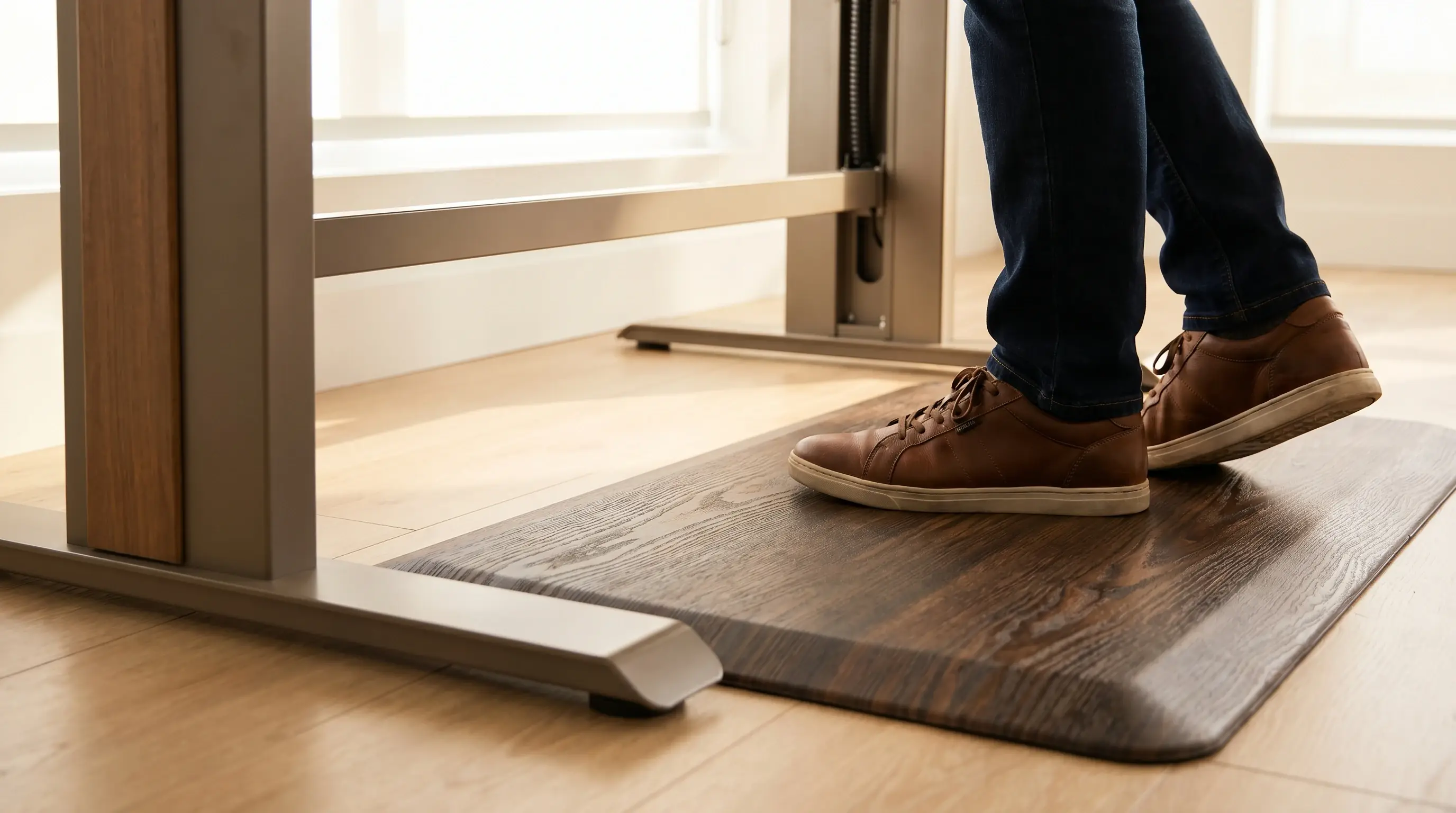
Standing for two hours straight on a hard floor is not good ergonomics. It’s just a different way to be uncomfortable. An anti-fatigue mat changes that by creating a slightly unstable surface that keeps your leg muscles making small adjustments, which improves circulation and reduces the static strain that builds up when you stand still.
The best anti-fatigue mat for a standing desk doesn’t need to cost $100+. Most people get everything they need from a $40-$60 mat. Here’s what’s worth buying in 2026.
If you’re not sure which type you need yet, read our how to choose an anti-fatigue mat guide first. It works through the four questions that actually narrow the field, floor type, flat vs. terrain, thickness, and size, and takes about five minutes. This page is the shortlist you buy from once those answers are settled.
This article contains affiliate links. If you buy through them, we may earn a small commission at no extra cost to you.
Quick Comparison
| Mat | Price | Size | Type | Best For |
|---|---|---|---|---|
| Topo by Ergodriven | ~$70 | 26” × 29” | Contoured terrain | Top overall pick |
| Sky Solutions Sky Mat | ~$45 | 20” × 32” | Flat foam | Best flat mat |
| Kangaroo Original | ~$40 | 20” × 32” | Flat foam | Best value |
| NewLife by GelPro | ~$75 | 20” × 36” | Gel-foam | Best for hard floors |
| ComfiLife Premium | ~$35 | 20” × 39” | Flat foam | Budget pick |
The Best Anti-Fatigue Mats for Standing Desks
Topo by Ergodriven
The Topo has a contoured surface with raised ridges and a center dome that encourages you to shift your weight and change your foot position throughout the day. That subtle movement is the whole point; passive standing on a flat mat is better than nothing, but active shifting is better than passive standing.
Check Price →Topo by Ergodriven: Best Overall
The Topo is the mat most frequently recommended by people who actually stand for hours a day, and for good reason. The uneven terrain (a raised center dome, angled side ridges, and a flat surround zone) gives you different places to put your feet without thinking about it. You find yourself shifting between the dome and the sides naturally.
It’s made from polyurethane foam, not the typical EVA foam on cheaper mats. That matters for durability. EVA compresses over time; the Topo holds its shape better after months of daily use.
What we like: The terrain design is genuinely different from flat mats, not just a marketing angle. It works. Also available in two sizes (the Topo and the smaller Topo Mini at ~$50) if the 26” × 29” footprint is too large for your setup.
What to watch for: It takes a couple of days to feel natural if you’re used to flat surfaces. Also thicker than most mats at 0.75”; some people find the raised edge a tripping hazard until they adapt.
Sky Solutions Sky Mat
The Sky Mat is the flat mat benchmark at this price. Beveled edges on all four sides prevent the lip-catching trips that plague cheaper mats. Clean design that fits under most standing desks without the mat being more noticeable than the desk.
Check Price →Sky Solutions Sky Mat: Best Flat Mat
If you prefer a flat surface (some people just don’t like the contoured feel of terrain mats), the Sky Mat is the best flat option under $50. The 3/4” foam is thicker than most at this price, and the beveled edges are a real feature, not marketing copy. Lots of cheaper mats have a raised edge that catches your sock when you step off it in the dark. The Sky Mat doesn’t.
Available in 20” × 32” and 20” × 36”. The 36” version is worth the few extra dollars if you move laterally while standing (shifting from keyboard to notebook, for example).
What we like: The beveled edge design is executed well. It’s a genuinely functional detail. Comes in multiple colors if the black square under your desk bothers you aesthetically.
What to watch for: Flat is flat. If your main problem is fatigue from static standing, a terrain mat like the Topo will serve you better. The Sky Mat is a comfort upgrade; the Topo is more of an ergonomics upgrade.
Kangaroo Original Standing Mat
The Kangaroo Original is the best-reviewed flat mat under $40 and holds up well under daily use. Basic, reliable, no frills: exactly what a budget pick should be.
Check Price →Kangaroo Original: Best Budget Flat Mat
The Kangaroo Original has been an Amazon best-seller in this category for years. It earns that position not through features, but through consistent quality at a low price. The 3/4” foam is firm enough to support your weight without bottoming out, and the anti-skid bottom keeps it from sliding on hardwood.
At ~$38 it’s the easiest recommendation for someone who just wants to stop standing on concrete and isn’t sure they want to spend more.
What we like: Widely available, frequently discounted, well-reviewed track record over multiple years. No surprise compression failures after three months.
What to watch for: The beveled edge isn’t as clean as the Sky Mat’s. Edge lifting can happen on low-pile carpet. Fine for hardwood or tile; on carpet, consider the Sky Mat instead.
NewLife by GelPro Designer Comfort Mat
The NewLife uses a gel-foam core rather than standard EVA, which gives it a different underfoot feel: slightly softer initial compression, but supportive underneath. It also looks considerably less like an industrial floor mat than most options at this price.
Check Price →NewLife by GelPro: Best for Hard Floors and Long Standing Sessions
GelPro makes kitchen mats and floor comfort products, not just standing desk accessories. The NewLife model brings that heritage to the home office. The gel-foam construction is noticeably softer underfoot than standard foam mats, which pays off during long standing sessions (3+ hour continuous stretches where regular foam starts feeling like packed dirt).
It’s also the nicest-looking mat on this list, with a textured pattern that reads as an actual floor accessory rather than an afterthought. If your home office is designed, this one doesn’t ruin it.
What we like: The gel-foam compression is more comfortable for extended standing than standard foam. The design options are genuinely attractive.
What to watch for: At ~$75 it’s the most expensive flat mat on this list. Justified if you stand for long stretches on a hard floor, harder to justify if you’re only standing 30-minute stints.
ComfiLife Premium Anti-Fatigue Mat
The ComfiLife is the lowest-priced mat on this list that we’d actually recommend. The 3/4” foam is real, not the thin 1/2” material you find on the cheapest mats, and it comes in a 20” × 39” size that gives you more room than most competitors at this price.
Check Price →ComfiLife Premium: Best Pure Budget Option
Under $35 with a 20” × 39” footprint is genuinely unusual. Most mats in this price range are either 1/2” thick (too thin for long sessions) or made from foam that compresses noticeably within the first few months. The ComfiLife hits a reasonable minimum spec: 3/4” foam, beveled edges, non-slip base.
The 39” length is the real differentiator. Taller people who take a wider stance while standing benefit from the extra width on either side.
What we like: The size for the price is hard to argue with. If you’re 6’2” and want a mat that won’t feel cramped, this is worth the small gamble.
What to watch for: This is a budget product. Durability over 18+ months is less predictable than the Kangaroo or Sky Mat. If you’re buying a mat to last three years, the Kangaroo Original is a better long-term bet at a slight price premium.
What to Look for in an Anti-Fatigue Mat
Thickness: 3/4” minimum
Mats sold at deep discounts are often 1/2” thick. That’s not enough cushioning for real standing sessions. Aim for 3/4” as the floor, and 1” for people who stand for long stretches.
Flat vs. terrain
Flat mats are more comfortable to stand on barefoot, easier to clean, and more predictable. Terrain mats (like the Topo) encourage movement and are better for ergonomics over long sessions. If you’re going to stand for four hours a day, the terrain mat is worth trying. If you’re standing for 45-minute windows, flat is fine.
Size
20” × 32” is the standard. It fits comfortably in front of most standing desks and doesn’t look oversized. Go larger (20” × 36” or 39”) if you’re tall or shift around a lot. The Topo’s 26” × 29” footprint is slightly wider and shorter; unusual, but works well in front of standard desks.
Beveled edges
The edge where the mat meets the floor is a tripping hazard if the transition is abrupt. All the mats on this list have beveled edges, but quality varies. The Sky Mat and Topo execute this best.
Floor type
Anti-skid backing works well on hardwood and tile. On carpet, some mats migrate over time. The Sky Mat handles low-pile carpet better than most. On thick carpet, the mat-on-carpet combination can feel unstable regardless of what you buy.
Do You Actually Need an Anti-Fatigue Mat?
If you’re standing for less than 30 minutes at a time on a padded floor, probably not urgently. If you’re standing for 60+ minutes at a stretch on hardwood or concrete subfloor, you’ll notice the difference quickly.
The research on anti-fatigue mats is consistent: they reduce reported discomfort in the lower back and legs during prolonged standing. The effect is meaningful at 3/4” thickness and above. Thinner mats don’t perform as well.
A standing desk without a mat is still worth using. A standing desk with a mat is easier to stay committed to. At $35-$75, it’s the cheapest ergonomics upgrade on your desk.
Bottom Line
The Topo by Ergodriven is the best anti-fatigue mat for standing desks if you’re serious about your time on your feet. The terrain design does something flat mats don’t, and the polyurethane foam holds up longer than standard EVA.
The Sky Mat is the best flat mat for the money. The Kangaroo Original is the right call if budget is the primary concern. The NewLife by GelPro wins on comfort for long sessions and on aesthetics.
Any of these will be a meaningful improvement over standing directly on a hard floor.
What to Read Next
An anti-fatigue mat is one piece of a complete standing desk setup. If you’re building out the rest:
- How to choose an anti-fatigue mat: the decision framework behind this list, floor type, flat vs. terrain, thickness, and sizing, if you want to check your reasoning before you buy
- Best desk cable management solutions under $50: the specific trays, sleeves, and clips for the cable cleanup that pairs with the mat
- Best standing desks under $300: where to start if you’re still desk shopping
- Best monitor arms for standing desks: the other accessory that makes standing desks actually work
- Best monitors for a standing desk: if you’re also due for a monitor upgrade, covers the specs that matter specifically for sit-stand use
- How to set up your standing desk for proper ergonomics: height settings, monitor position, standing intervals; includes guidance on how long to stand per session
- Complete ergonomic desk setup under $300: if you want to build the whole setup on a budget
- Cable management guide for standing desks: once the mat is in place, this is the other 30-minute fix that makes a standing desk setup actually clean
- How long to stand at a standing desk: realistic schedules for alternating sitting and standing, including when a mat makes the biggest difference
- Minimalist standing desk setup guide: if you want to keep the desk surface clean once all the hardware is in place; covers which accessories earn a permanent spot and which ones to leave off
- Standing desk vs. desk converter guide: if you’re still deciding whether a full desk or a converter is the right move; a mat is a good investment either way, but knowing which platform you’ll land on first changes some accessory choices
Prices and availability are accurate as of publication and updated regularly.